
For US-based NRIs investing in India, managing taxes and compliance can feel like walking a tightrope between two systems — India’s and the United States’. Between FATCA declarations, DTAA benefits, PFIC reporting, and FEMA rules, even a small oversight can lead to double taxation or compliance issues. This blog offers a practical, step-by-step guide to simplify the complex world of NRI tax compliance India US and help you invest confidently.
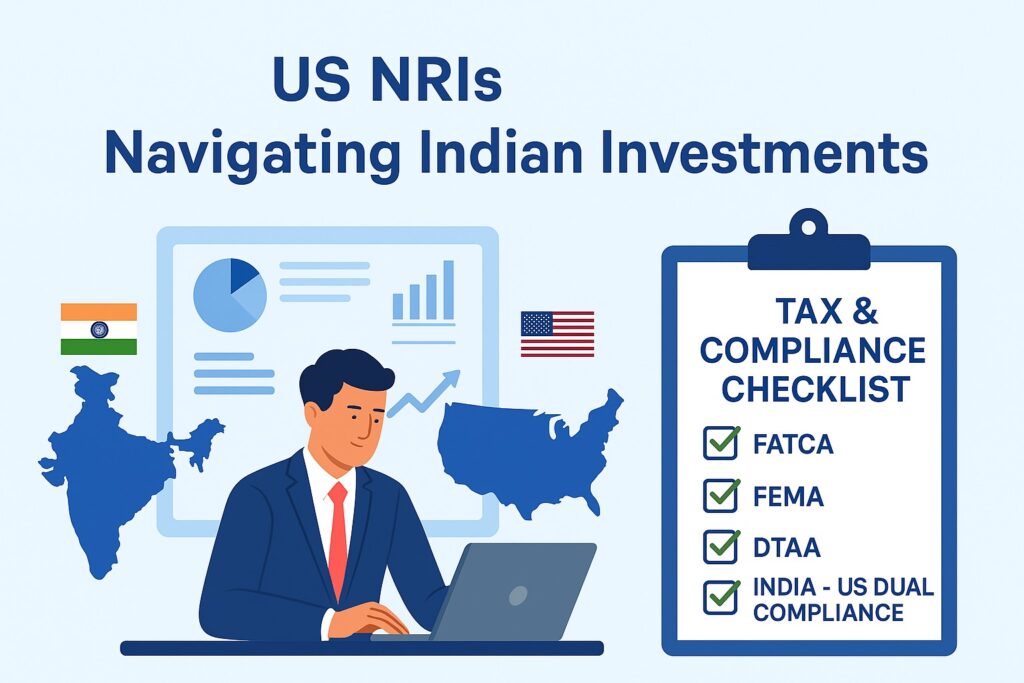
Table of Contents
Why Tax & Compliance Are Critical for US-Based NRIs
NRIs in the US have to meet both Indian and American tax laws, which often overlap. FATCA (Foreign Account Tax Compliance Act) mandates disclosure of foreign assets to the IRS, while FEMA (Foreign Exchange Management Act) governs how NRIs can hold and transfer money in India. The Double Taxation Avoidance Agreement (DTAA) between India and the US is your best friend—it ensures you don’t pay tax twice on the same income.
FATCA, FEMA, and DTAA Explained Simply
Under FATCA, Indian banks and mutual fund companies report NRI account details to US tax authorities if the value exceeds $50,000. Under FEMA, all Indian investments by NRIs must flow through NRE or NRO accounts. The DTAA allows you to claim tax credit in one country for tax paid in the other. Together, these rules define how your money moves and how it’s taxed.
Investment Options for US-Based NRIs in India
Mutual Funds: Not all Indian fund houses accept US-based investors due to FATCA compliance, but AMCs like ICICI Prudential, SBI, and Parag Parikh do. Always invest through your NRE or NRO account—not directly from your US bank—to stay compliant.
Stocks & ETFs: You can invest through a Portfolio Investment Scheme (PIS) linked to your NRE/NRO account. Capital gains from these investments are taxable in India and must be reported in your US tax filings as well.
Fixed Deposits & Bonds: Interest on NRE deposits is tax-free in India but taxable in the US. NRO deposits attract 30% TDS in India, but you can offset that under DTAA.
Real Estate: You can buy residential or commercial property in India but not agricultural land. Rental income is taxable in India, and you must comply with repatriation limits when selling.
Taxation Framework for US-Based NRIs
| Investment Type | Tax in India | Tax in US | DTAA Benefit |
|---|---|---|---|
| NRE Fixed Deposit | Exempt | Taxable | Yes |
| NRO Fixed Deposit | 30% TDS | Taxable | Yes |
| Mutual Funds | STCG/LTCG | Taxable | Yes |
| Stocks | 15% (STCG) / 10% (LTCG) | Taxable | Yes |
| Real Estate | 20% with indexation | Taxable | Yes |
Common Mistakes NRIs Make with Indian Investments
Many US-based NRIs make avoidable errors—using resident accounts for transactions, ignoring FATCA reporting for smaller holdings, or assuming NRE interest is tax-free globally. Some fail to convert capital gains into USD while filing US returns, while others skip claiming DTAA credit, leading to unnecessary double taxation.
Step-by-Step Compliance Checklist
Step 1: Classify your Indian accounts correctly as NRE or NRO.
Step 2: Maintain digital records of your investments—folios, contract notes, and TDS certificates.
Step 3: File ITR-2 in India and Form 8938 plus FBAR in the US if thresholds apply.
Step 4: Claim DTAA credits while filing your US returns to avoid double taxation.
Step 5: Consult a cross-border tax advisor familiar with both Indian and US filing systems.
Real-Life Example
Arjun, an NRI based in California, invests ₹25 lakh in Indian mutual funds through his NRE account. He pays 10% LTCG tax in India and reports it on his US return under IRS Form 8938. Using the DTAA, he claims credit for tax already paid in India, effectively eliminating double taxation. This is how correct filing saves both money and hassle.
Top Fintech Tools for Cross-Border Tax Management
INDmoney: Integrates Indian and US portfolios and provides downloadable tax summaries.
Vested: Tracks US investments in INR and simplifies global portfolio visibility.
ClearTax NRI Suite: Helps NRIs file returns in India and claim DTAA credits.
Revolut or Wise: Ideal for fast, low-cost international remittances and conversions.
FAQs on NRI Tax Compliance India US
Can I invest in SIPs from the US? Yes, through select AMCs that accept US investors.
Do I pay tax twice? No, if you file correctly using DTAA.
Should I report Indian bank balances to the IRS? Yes, if they exceed FATCA or FBAR limits.
Final Thoughts: Compliance is the Foundation of Smart Investing
For US-based NRIs, success in Indian investments isn’t just about returns—it’s about doing it right. A strong understanding of NRI tax compliance India US rules, use of digital tools, and proper documentation ensures your cross-border wealth journey remains stress-free. With planning and the right advice, you can grow your assets in India while staying fully compliant abroad.
Internal Link:
How to Manage Your Indian Finances While Living Abroad
External Links:
RBI FEMA Regulations
IRS FATCA Guidelines
FinEdge NRI Investment Insights